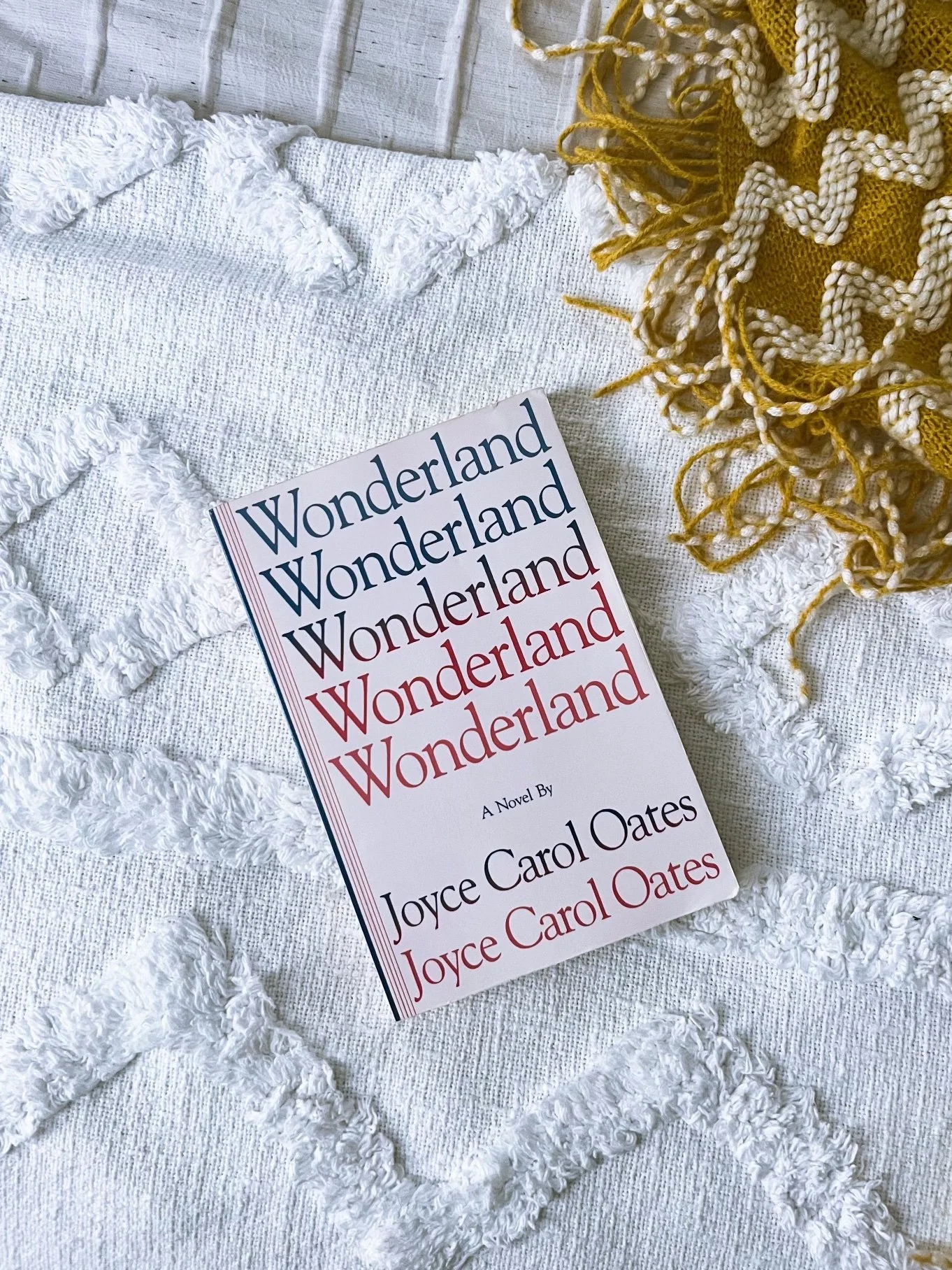
Wonderland
The literary term of the week is bildungsroman. It’s an old clunky word used to refer to coming-of-age stories. Dickens’s David Copperfield is an example of bildungsroman, and perhaps one of the more accessible comparisons to Wonderland.
Jesse is a son in a blue-collar family in upstate New York who returns home from school to discover his father shot and killed his siblings and mother. Though he manages to escape, his father turns the gun on himself and makes Jesse sole survivor of the entire family. Jesse is eventually taken in by the affluent Connecticut doctor Karl Pederson, who raises him alongside his two other children. His assimilation into the Pederson family is awkward. Like their father, the teenage Pederson children are brilliant and have already been excused from school because they’re that smart. An uncomfortable adjustment for modest Jesse, who seemingly is of average intelligence with a sub-par reading level. Yet somehow this all changes when Dr. Pederson pushes Jesse to study the sciences. This sets off something in Jesse that compels him to study medical textbooks and posit himself to follow in his foster father’s footsteps. Jesse seems to do an entire one-eighty at this point in the novel. He recites entire chunks of text from scientific research journals, he accompanies Dr. Pederson to the hospital for patient visits, and eventually gets accepted into Ann Arbor’s medical school on an academic scholarship.
It was generally compelling to absorb such character transformation, but I found Jesse didn’t quite earn this new role. There needed to be something in the middle between quiet Jesse from a modest backwoods background with no promising future, to the brilliant, photographic memory Jesse, who gets the free ride to Ann Arbor. It was all too much of a leap for me.
The adult Jesse is far more believable and complex. The second third of Wonderland is largely concerned with Jesse as a young graduate student. He also meets Helene, the daughter of a well-respected physician and his future wife. What begins as a romance, the type of relationship he ends up having with Helene is tense, distant, and unsatisfying. Having committed his life to the study of medicine, Jesse’s one-track mind struggles to connect emotionally with Helene, and eventually his daughters.
In the most captivating portion of the novel—Oates’s final 85 or so pages—Jesse’s younger daughter Shelley falls victim to the allure of the sixties counterculture and runs away from home with a manipulative boyfriend. Jesse’s complex relationship with this issue seems to be the only point in the novel in which he truly allows himself to feel vulnerable.
Wonderland is a bildungsroman but it’s also a trajectory of a life of repressed emotional trauma. Jesse surmounts considerable obstacles to attain status in the medical field but at the cost of relatability and emotional connection. No one should ever live the life Jesse Vogel has in Wonderland. Yet everyone should read about him.
This a standout piece of fiction by anyone’s standard. The writing is full of emotion and drama, sometimes on a visceral level. Oates has mentioned this was the most difficult of all her books to write. And anyone who reads this will understand why, considering the layers of psychology applied to the characters.
I am going to give this an A-minus. The writing is gorgeous without being flowery. Jesse Vogel is a generally very compelling main character with a prominent arc—even if Oates reaches too much here and there. The only legitimate complaint: I wish Shelley’s engulfment in the counterculture was longer. This was really when Jesse’s character was being tested the most, and making the best choices.
Wonderland is authored by an iconic American writer who was approaching her pinnacle. I recommend the beautiful 1992 paperback edition from my IG.