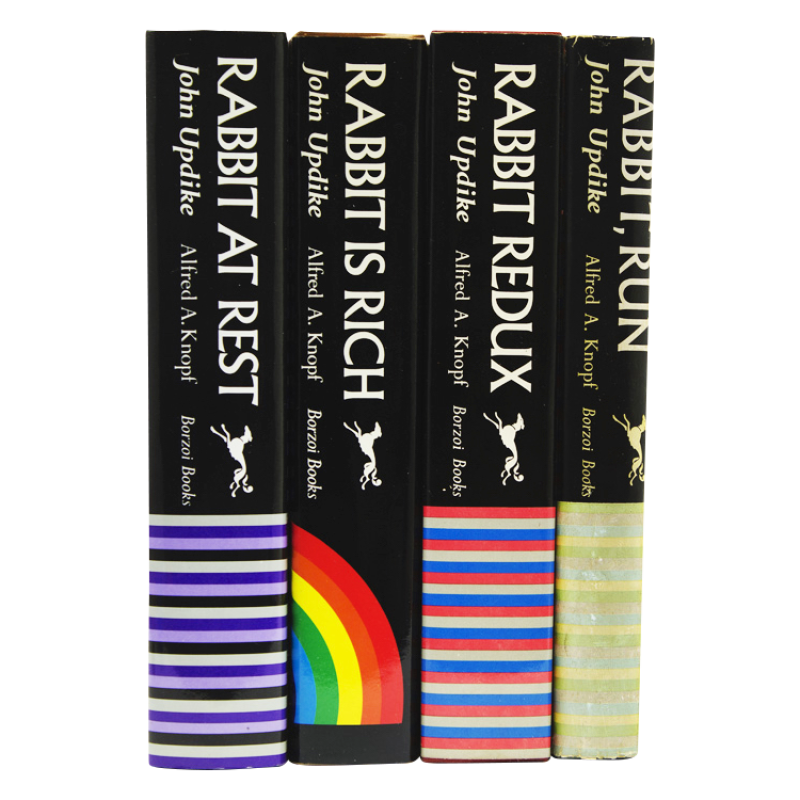
John Updike's 'Rabbit' Novels
Harry “Rabbit” Angstrom peaked in high school. He was a local basketball star who made the local papers and showed promise of doing “big things” in adulthood. Unfortunately, adulthood did not pan out as such for Rabbit; he works a dead-end job, lives in a small apartment, has no social life to speak of, and his wife Janice is a stay-at-home mom with a drinking problem. From page one, Rabbit feels an urge to break away from the monotony of domestic married life, provoked by a basketball game with a group of kids. When Rabbit comes home to an empty, messy apartment, he is met with his breaking point and leaves on a whim without notice.
The bulk of the plot is his affair with a prostitute before being influenced to return to the family nest by a minister. Rabbit Run is a tragic and raw look at domestic partnership gone awry. For 1960, I’m sure this was an iconoclastic book for its profanity and frank depictions of adultery. It may not be the great novel of the last century, but still a compelling piece of Americana for the serious lit reader.
The sequel Rabbit Redux works a little less effectively but succeeds in building Rabbit’s character further and establishing the period flavor of 1969. Rabbit now works at a local manufacturing plant, enabling a comfortable middle-class living for Janice and teenage son Nelson. After getting caught cheating, Janice decides she needs time to think their marriage over and moves in with her boyfriend. No stranger to adultery himself, Rabbit takes up with a hippie chick, tries marijuana, and samples the lifestyle the counterculture has to offer. Nelson meanwhile bears the brunt of his parents’ separation; he is exposed to inappropriate new household norms related to Rabbit’s new girlfriend and another live-in character named Skeeter.
I enjoyed Rabbit Redux yet I feel Updike was more interested in demonstrating his knowledge of the hippie culture and substance abuse than sustaining a fluid storyline. It isn’t a brilliant companion piece to its predecessor yet still worth a look. In any case, John Updike wrote it; it’s definitely better than your average sequel.
Rabbit is Rich is my favorite of the Updike novels I’ve read and also happens to be the most X-rated. I think what I like about Updike is his capacity to create larger-than-life prose befitting of contemporary American lit while also getting away with very racy material. In what is the most amusing and graphic section of the novel Rabbit and Janice take a vacation to the Caribbean with two other couples. What starts as vague sexual tension on the trip with the wife of one of Rabbit’s buddies, culminates in a spouse-swapping night involving anal and golden showers.
It’s a fun, amusing exploration of late-70s America albeit occasionally cringe; Rabbit invariably calls Janice a “mutt,” vaginas are referred to as “cunts,” and female physical descriptions typically contain some comment on breast size. It’s not a P.C. book by any means, so if you’re easily offended, you’re better off glossing over Rabbit Angstrom as he’s definitely not everyone’s cup of tea.
Rabbit At Rest finds the anti-hero semi-retired, snowbirding in Florida, and overweight. Nelson has taken the reins at his Toyota dealership, crack and cocaine habits notwithstanding. Rabbit also has two grandkids he occasionally connects with and a daughter-in-law he sexualizes whenever she’s on the page. Much of this final installment involves Rabbit coming to equal terms with his heart condition and his son’s substance abuse. It’s arguably the least happy of the four books, though extremely well-written. I’ve seen this one cited as the best but it just misses that rating for me. There aren’t as many fun diversions and much more focus on the bleak prognosis of Rabbit’s health.
Overall- Rabbit Run gets an A, Redux a B-, Rich is an A+, and Rest is a B.
Updike has a quartet of superb American novels here but I think only the most open-minded of readers should explore them.