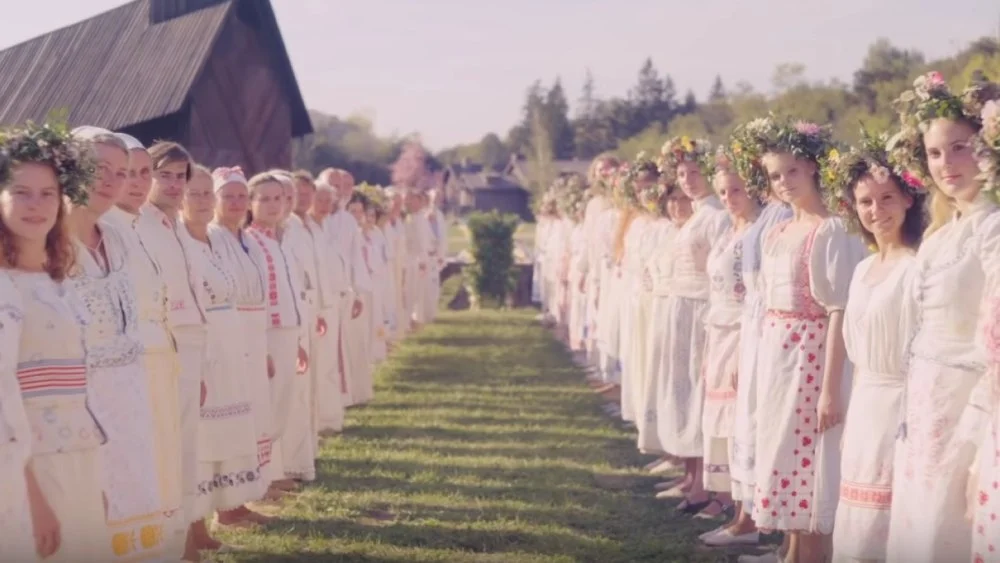
Midsommar
I saw this movie twice in four days. Even after such exposure, I still don’t know exactly where to begin in explaining how excellent this film is. I will however make a bold statement here, and it may rock the purists who are into these types of films as well, but you know what, it’s about time I got more opinionated on here anyhow. The original storytelling, poignant soundtrack, gorgeous cinematography, and superb acting—particularly from female lead Florence Pugh—outdoes director Ari Aster’s previous gem, Hereditary. There it is. Said.
We begin with Dani Ardor (Pugh) getting hit with some awful news. Her father and mother die of carbon monoxide poisoning at the hands of a bipolar sister. This news comes at a particularly iffy time for Dani, as we see her boyfriend Christian is growing disinterested in their relationship, and even discusses the possibility of a break-up with his friends. Poor Dani never knows this, but what she does discover is news of his month-long assignment to Sweden for an anthropology project. In a half-assed effort to set things right (this guy is actually a tool to most people in this movie), Christian invites Dani to come along on the trip. Dani decides to accept Christian’s invitation, and they head to Halsingland, Sweden with a group of his friends, one of which is another anthropology student, and slighted by Christian’s last-minute choice to do his project on Halsingland. Like I mentioned—a real stand-up guy, Christian.
When they reach their destination, the group almost immediately takes mushrooms and trips in the open fields of Halsingland. This proves adverse for Dani, who is still in the throes of post-traumatic grief at the loss of her parents, and demonstrates triggered panic at any mentioning of family. In this scene, we get the first sampling of how Midsommar conveys hallucinogenic imagery. Effects are used to simulate the breathing of flowers and trees, and this is has a very natural, ethereal quality.
The small village in the section of Halsingland in which this film largely takes place is populated by people who have just begun a festival called (you got it) Midsommar. The custom, which takes place every ninety years, is a seasonal celebration of gods, crops, and, as it turns out, sacrifice. And I will not divulge any further details about the latter aspect of this festival—only to make mention that there is a level of viscera and gore that will turn off some of the more squeamish viewers.
The journey of director Ari Aster’s second film, from family tragedy to the reveal of myriad cult rituals and traditions amid a sunny pastoral backdrop, feels like nothing I have seen before not only in the horror genre, but in any category of film. The feeling of dread and unease is well-mounted, and every thrill is well-earned. Midsommar does something else I love as well—it stays away from jump scares!
Aster has recently commented in an interview that this is a break-up movie, and after the second viewing I’ve gone on to believe this. If you aren’t fully satisfied with the ending, then I don’t know what to do for you. All I’m saying is this: see this movie.